Working time records in Hungary: what the Labour Code requires
Under the Hungarian Labour Code the employer keeps a record of the length of regular and overtime work, standby and leave, and the record must show, up to date, when work started and ended (Mt. § 134). The parties cannot agree otherwise. This guide goes through what has to be recorded, which limits to watch when scheduling, and how a small company can keep the record. General information based on the Act's text, not legal advice.
Published: · By the HelloCRM team
The core CRM is free forever. Pre-register and be among the first in.
What must the employer record?
Under § 134(1) of the Labour Code the employer records the length of regular and overtime work, of standby and of leave, and the voluntary overtime worked under a written agreement. Under paragraph (4) the agreements behind these must be kept on record too: for example one on longer full-time hours or on voluntary overtime.
- Regular working time: what was worked under the schedule.
- Overtime: work ordered beyond the schedule.
- Standby: when the employee is on call outside working hours.
- Leave: how many days, and when.
- The written agreements that go with these.
Under § 135(1)(h) neither an agreement between the parties nor a collective agreement may depart from § 134, so the record is not an obligation an employment contract can waive.
What does an up-to-date record mean?
Under § 134(2) the record must show, up to date, when regular work, overtime and standby started and ended. So it is not enough to write down at the end of the month how many hours someone worked in total: it must show, day by day, when they started and when they finished.
Paragraph (3) allows a simpler way for regular work and overtime: the record can be kept by certifying the written schedule at the end of the month and noting any change on the day it happens. If someone worked to the schedule, nothing has to be written in again every day; if they did not, the difference is recorded that day.
The Act sets out what the record must contain, not its form: it can be on paper or electronic, as long as the data above can be read from it up to date. Whether your own solution meets that is worth checking with an employment lawyer or your accountant.
Which limits should you watch when scheduling?
Details
| Rule | What it says | Where it is |
|---|---|---|
| General full-time day | eight hours a day | § 92(1) |
| Shortest scheduled day | four hours, except part-time | § 99(1) |
| Longest scheduled day and week | twelve hours a day, forty-eight a week | § 99(2) |
| Daily rest | at least eleven consecutive hours between two working days | § 104(1) |
| Overtime | two hundred and fifty hours a calendar year | § 109(1) |
| Voluntary overtime | by written agreement up to a further hundred and fifty hours, which can be ended at the end of the calendar year | § 109(2) |
The Act allows departures from these in some cases, for example by collective agreement (§ 135), or a different daily rest in certain working patterns (§ 104(2)). If employment started during the year, or is fixed-term or part-time, the overtime caps apply in proportion (§ 109(3)).
How do you keep the record of leave?
Details
The length of leave is part of the same record (§ 134(1)(c)). Basic leave is twenty working days (§ 116), with extra days for age and children (§§ 117-118). Leave is counted in working days, so the record has to know which days are public holidays and which Saturday became a moved working day.
The rules on giving leave (who decides, how many days must be given at the employee's request, and how far ahead the dates are communicated) are summed up in the short answer on annual leave.
How can a small company keep it in practice?
Details
- Write the schedule in advance and tell colleagues in writing.
- A day worked to the schedule is fine as it is; record any difference (started earlier, stayed later) that same day.
- Mark overtime separately, because it has a yearly cap.
- Run leave through a request and an approval, counted in working days.
- At the end of the month have the schedule and the differences certified.
- Keep the written agreements (voluntary overtime, for example) with the record.
The most common mistake is keeping the record only to work out pay, once a month, in totals. Then it lacks exactly what the Act asks for: start and finish visible day by day, or at least the schedule and any departure from it.
What should you check in the record each month?
Details
- Whether every working day shows start and finish, or the schedule and any departure from it.
- Whether any day was scheduled over twelve hours, or any week over forty-eight.
- Whether there were eleven hours of rest between working days, where the general rule applies.
- Where each colleague's overtime stands against the yearly cap.
- Whether leave taken matches the approved requests, and how much is left.
Tie this monthly look to the day the payroll data goes to the accountant: that is when a missing day or an unrecorded change comes to light in time, while someone still remembers what happened.
What does HelloCRM do for this?
Details
Honestly: HelloCRM's Time tracking module is made for accounting for work and billing it. It records time worked per day, in minutes, against a customer, a deal or a project, with no start or end time. A weekly timesheet can be submitted and approved, a submitted week is locked, and you can choose to bill only time in approved weeks. On its own that is not the record § 134(2) describes.
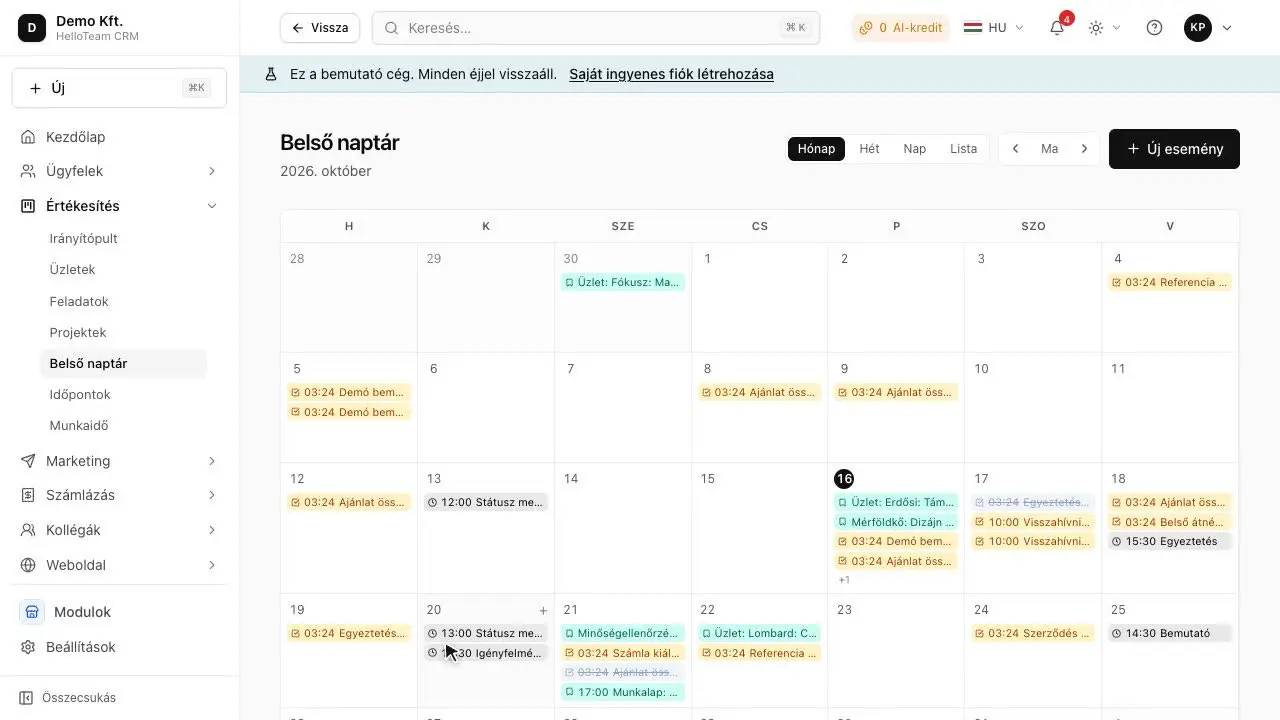
In the People module, though, the schedule is made shift by shift with a start and an end time, one person's two shifts cannot overlap, and a colleague is notified when the schedule is published. Leave goes through a request and an approval, counted in working days with Hungarian public holidays; a moved working day is entered by an administrator. If you use the method in paragraph (3) (a written schedule, certified monthly, changes noted on the day), these give you a good base; whether they are enough in your case is one to check with a professional.
In short
The employer records the length of regular work, overtime, standby and leave, and start and finish must be readable up to date; no agreement can waive this. A simpler way is certifying the written schedule monthly and noting changes on the day. When scheduling, twelve hours a day, forty-eight a week and eleven hours of rest are the main limits, and overtime is capped at two hundred and fifty hours a year.
Where to read on
Questions
Does a small company need working time records too?
Yes: § 134 of the Labour Code applies to every employer whatever its size, and under § 135(1) the parties cannot agree otherwise.
Is a monthly total of hours enough?
No: under § 134(2) start and end times must be readable up to date. Under paragraph (3), certifying the written schedule monthly and noting changes on the day is also enough for regular work and overtime.
How much overtime can be ordered in a year?
Two hundred and fifty hours a calendar year (§ 109(1)); with a written agreement up to a further hundred and fifty hours of voluntary overtime (§ 109(2)), and under a collective agreement the limits in § 135(3).
Can working time records be kept electronically?
§ 134 sets out what the record must contain, not its form; what matters is that start, finish and length can be read from it up to date.
Sources
This is general information, not legal or tax advice. The rules come from: 2012. évi I. törvény a munka törvénykönyvéről (Mt.), Nemzeti Jogszabálytár (checked )