CRM and the GDPR: what to know when you store customer data
If your CRM holds data about natural persons (a private customer, or the name and email of a contact person at a company), the GDPR applies to it. In practice five things have to be kept in order: every item needs a legal basis, store only what is needed, hand it over or erase it on request, limit who has access, and have an agreement with the CRM provider. This is general information based on the regulation's text, not legal advice.
Published: · By the HelloCRM team
The core CRM is free forever. Pre-register and be among the first in.
Does the GDPR apply to a small company's CRM?
Yes, when it stores data about an identifiable natural person: under the GDPR personal data is any information relating to an identified or identifiable person (Article 4(1)). That covers a private customer's name and phone number, and also the name and work email of a contact person at a company. The company itself, its name and its tax number are not personal data.
Size is no exemption: the regulation applies to a company of three as much as to a large one. Smaller organisations may be exempt from some record-keeping duties under certain conditions (Article 30(5)); whether that applies to you is worth settling with a data protection adviser.
On what legal basis may you store customer data?
The GDPR lists six legal bases (Article 6(1)): consent, performance of a contract, a legal obligation, vital interests, a task in the public interest and legitimate interests. In a CRM most data rests on a contract (someone you quote or contract with), a legal obligation (keeping invoices, say) or legitimate interests. A newsletter typically rests on consent.
It is worth writing down, per kind of customer, which basis you rely on, because that is what you must state when asked or checked. Under the accountability principle the regulation also requires that you can demonstrate compliance (Article 5(2)).
What does data minimisation mean in a CRM?
Details
It means collecting only the data the purpose needs (Article 5(1)(c)) and keeping it only as long as needed (point (e)). In a CRM that means not adding a custom field for things nobody uses (a birthday, an ID card number), and reviewing long-inactive contacts now and then.
What should you know about consent and newsletters?
Details
If you rely on consent, you must be able to demonstrate that the person consented (Article 7(1)), and withdrawing must be as easy as giving it (Article 7(3)). So for a newsletter it is worth keeping what someone accepted, when and in what wording, and every mail should carry an unsubscribe link.
A person may object to direct marketing at any time, and their data may then no longer be used for it (Article 21(2) and (3)). The guide on email marketing lists the practical minimum.
What do you do when someone asks for their data or erasure?
Details
A person has the right to learn what data you hold about them and get a copy (Article 15), to ask for correction (Article 16), in certain cases erasure (Article 17), and to receive the data they provided in a machine-readable form (Article 20). You must answer without undue delay and at the latest within one month, which can be extended by two further months where justified (Article 12(3)).
Erasure is not always total: what a legal obligation requires you to keep, an issued invoice for example, stays. The hard part is that in a CRM one person can appear in many places: on the contact, in a shop order, in an appointment, in a webhook that was sent. Erasure has to reach those copies too.
Who may access customer data?
Details
The regulation asks for appropriate technical and organisational measures to secure the data (Article 32). In a small company's CRM that means three things: everyone signs in with their own account, and nobody shares a password; a colleague sees only what their work needs; and signing in has a second factor, an authenticator app for example.
When someone leaves, their access should end on their last day, and their open work should move to a colleague, so no customer is left without an owner.
Do you need an agreement with the CRM provider?
Details
Yes. A cloud CRM provider handles your customers' data on your behalf, so it is a processor, and the GDPR requires a written agreement with it that sets out, for example, that it may process the data only on your instructions (Article 28). Also check where the data is stored, and whether you can take it out if you switch.
What do you do after a personal data breach?
Details
If a breach (a lost laptop, say, or a customer list mailed to the wrong address) poses a risk to the people concerned, it must be reported to the supervisory authority without undue delay and, where feasible, within 72 hours (Article 33(1)), and where the risk is high the people concerned must be told too (Article 34). It is worth knowing in advance who decides this in your company.
What does HelloCRM provide for this?
Details
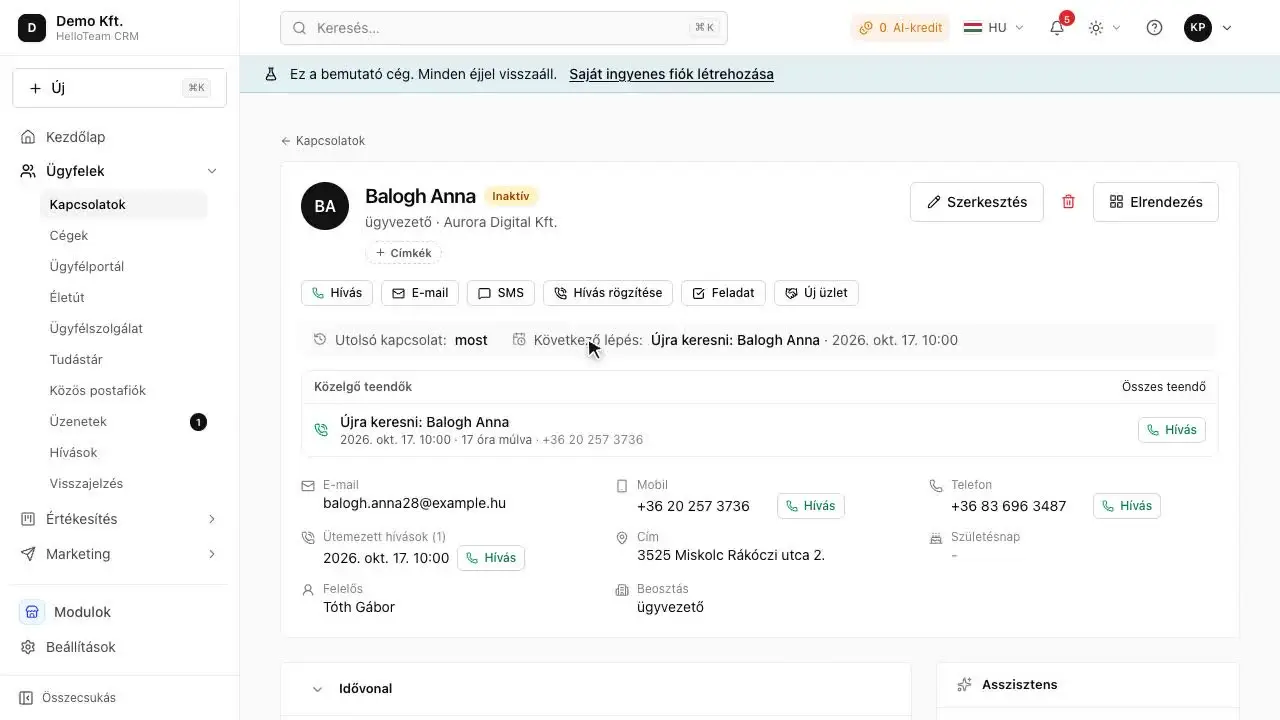
- Everything held about a customer can be exported in one click, and erasure reaches the copies too: shop orders, webhooks, appointments.
- Forms can switch on double opt-in: consent is recorded at the click, with the wording shown, the time and the IP address.
- Roles and record-level visibility: a colleague can be limited to their own customers.
- Two-step sign-in with an authenticator app, and an audit log of what was done.
- A leaving colleague's access ends after their last working day, and their open work can be handed over.
- The GDPR tools are part of the free plan. The agreement names where the data is hosted, and there is a self-hosted plan too.
These are tools: the legal basis, the retention periods and the privacy notice are yours to decide, preferably with a data protection adviser.
In short
The GDPR applies to a CRM whenever it stores data about natural persons, whatever the company's size. Every item needs a legal basis, keep only what is needed, answer data requests within a month, limit access, and sign a processing agreement with the provider. HelloCRM provides tools for this (a one-click export, erasure that reaches the copies, a consent record, record-level visibility), but the decisions are yours.
Where to read on
Questions
Is a contact person's work email address personal data?
Yes, when it belongs to an identifiable person (firstname.lastname@company.com, say): under Article 4 of the GDPR any information relating to an identifiable natural person is personal data. A general info@ address is not tied to a person.
How long do I have to answer a data request?
Without undue delay and at the latest within one month; where justified this can be extended by two further months, and the person must be told (GDPR Article 12(3)).
Must I delete the invoice too if the customer asks for erasure?
No: what a legal obligation requires you to keep stays after an erasure request (GDPR Article 17(3)(b)). The rest, such as a newsletter subscription, must go.
Do I need a processing agreement with a cloud CRM?
Yes: the provider processes the data on your behalf, and Article 28 of the GDPR requires a written agreement with it, setting out what it may use the data for and how it helps you answer requests.
Sources
This is general information, not legal or tax advice. The rules come from: Az (EU) 2016/679 rendelet (GDPR), EUR-Lex (checked )