Quote template: what goes into a quote, and how to send it
A good quote states ten things plainly: who is offering, to whom, what, for how much (net, VAT, gross), on what terms, by when, how long it is valid, what is not included, whom to contact, and how to accept it. This article goes through the parts, gives a template you can adapt, and shows how an accepted quote becomes an invoice without retyping.
Published: · By the HelloCRM team
The core CRM is free forever. Pre-register and be among the first in.
What is a quote, and what is a template for?
A quote is a written offer to a buyer setting out what the company would supply, at what price and on what terms. The customer decides from it, so it must hold everything they need to decide and nothing that only confuses them.
A template helps because every quote is made in the same order with the same parts. Colleagues stop forgetting the validity or the payment terms, and by the second quote the customer already knows where to look for the total.
What should a quote contain?
- Your company's name, address, tax number and contact details.
- The customer's name and address, and for a company the contact person's name.
- The quote's number and date, so both sides refer to the same document later.
- The lines: description, quantity, unit, unit price and VAT rate.
- The summary: the net total, the VAT and the gross total, in one currency.
- Delivery: when, where and how the customer gets what they order.
- Payment terms: the method, the due date and, if needed, an advance.
- Validity: how long you hold the price.
- What is not included: travel, materials, licences, or anything the customer would otherwise assume.
- How to accept: a signature, a reply, or one click on a link.
Most disputes about lines come from the customer reading a line differently from you. Instead of "website" write "a five-page company website with two rounds of changes"; instead of "installation" write "on-site fitting, one day, materials not included".
What does a template you can adapt look like?
Details
The outline below is a quote from an invented joinery workshop; put your own details in place of the square brackets. The order is the point: the reader sees what they get first, then for how much, and last what they need to do.
- Header: [Company name], [address], tax number: [tax number], [phone], [email].
- To: [Customer name], [address], contact: [name].
- Quote number: [number], dated [date], valid until [date].
- Subject: making and fitting a built-in kitchen at [address].
- Lines: 1. base units, [quantity] m, [unit price]; 2. wall units, [quantity] m, [unit price]; 3. worktop, [quantity] m, [unit price]; 4. on-site fitting, 1 day, [unit price].
- Total: net [amount], VAT [rate] [amount], gross [amount].
- Delivery: within [number] weeks of the order, on a day agreed in advance.
- Payment: [share] as an advance with the order, the rest after fitting, by transfer within [number] days.
- Not included: removing the old units, connecting the appliances.
- To accept: reply to this email, or accept the quote on the link.
If you send the same kind of quote often, save its lines as products or services, so the description and the unit price are the same in every quote.
How long should a quote be valid?
Details
For as long as you can hold your prices. If material costs move quickly, keep it short; if you price a service whose cost stays the same for months, it can be longer. What matters is that there is a date: a quote with no date is one a customer can point to half a year later.
If it has lapsed and the customer still wants to accept, send a new quote at today's prices rather than extending the old one by word of mouth. That way both sides hold the same paper.
Is a quote an invoice?
Details
No. A quote is not an invoice: it creates no obligation to pay and is not reported to NAV's Online Számla system. The invoice is made when you have delivered, or when an advance arrives; a proforma may sit in between, and it is not an invoice either.
This is general information, not tax advice; when and which invoice you need is a question for your accountant.
How do you send it, and how does it become an invoice?
Details
As a PDF by email, or as a link on which the customer can also accept it. The link has the advantage that nobody needs to write back: they type their name, tick that they accept, and you see it at once.
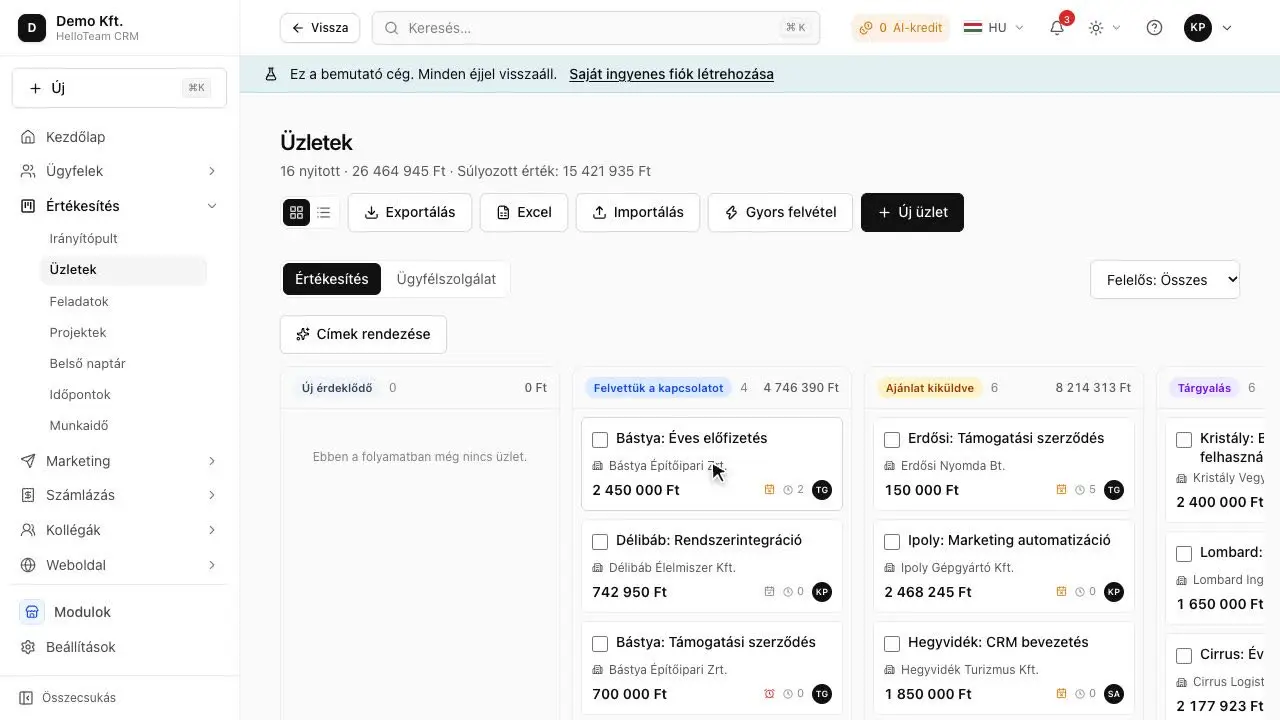
HelloCRM's Quotes module works like this. When you send a quote, it and its lines are frozen into a numbered revision, so if you change it and send again, the second revision does not overwrite the first. The customer can only accept the latest one; the decision is recorded with the name, the time and a fingerprint of the quote.
Once accepted, one press makes it a draft invoice in the Invoicing module, with the lines, the discount, the payment method and the terms carried over, so the two totals agree. Both modules are paid add-ons, with a free 3-day trial each.
Which mistakes are worth avoiding?
Details
- Only a gross or only a net figure: a company cares about net, a private customer about gross, so give both.
- A quote with no validity date, referred to months later.
- A discount agreed by phone that is missing from the quote and causes an argument on the invoice.
- One file edited several times and sent again under the same name.
- An accepted quote retyped into the invoice by hand, with one line wrong.
In short
A good quote says who offers what to whom and for how much (net, VAT, gross), on what terms and by when, how long it is valid, what is not included and how to accept it. A quote is not an invoice; in HelloCRM an accepted quote becomes a draft invoice in one press, so the two totals agree.
Where to read on
Questions
Is a quote compulsory?
No: a quote helps the buyer decide and is not a tax document. Many companies still give one for every job, because it records in writing what was agreed.
What is the difference between a quote and a proforma?
A quote is an offer the customer accepts or not; a proforma is a request for payment you send after you have agreed. Neither is an invoice.
Can the customer accept it on a link?
In HelloCRM, yes: they type their name, tick to accept, and the decision is recorded against the revision they saw.
Can I change a quote after sending it?
Yes, and sending it again makes a new revision; an accepted quote can no longer be changed, so a new quote is needed instead.
Sources
This is general information, not legal or tax advice. The rules come from: NAV Online Számla (checked ); 2007. évi CXXVII. törvény az általános forgalmi adóról (Áfa tv.), Nemzeti Jogszabálytár (checked )