Sales pipeline basics that actually matter
A sales pipeline is useful because every open deal has an owner, a next step and a clear stage. This article sums up how to set up four to six stages people understand, what weekly routine keeps the board current, and why a weighted forecast needs care.
Published: · Updated: · By the HelloCRM team
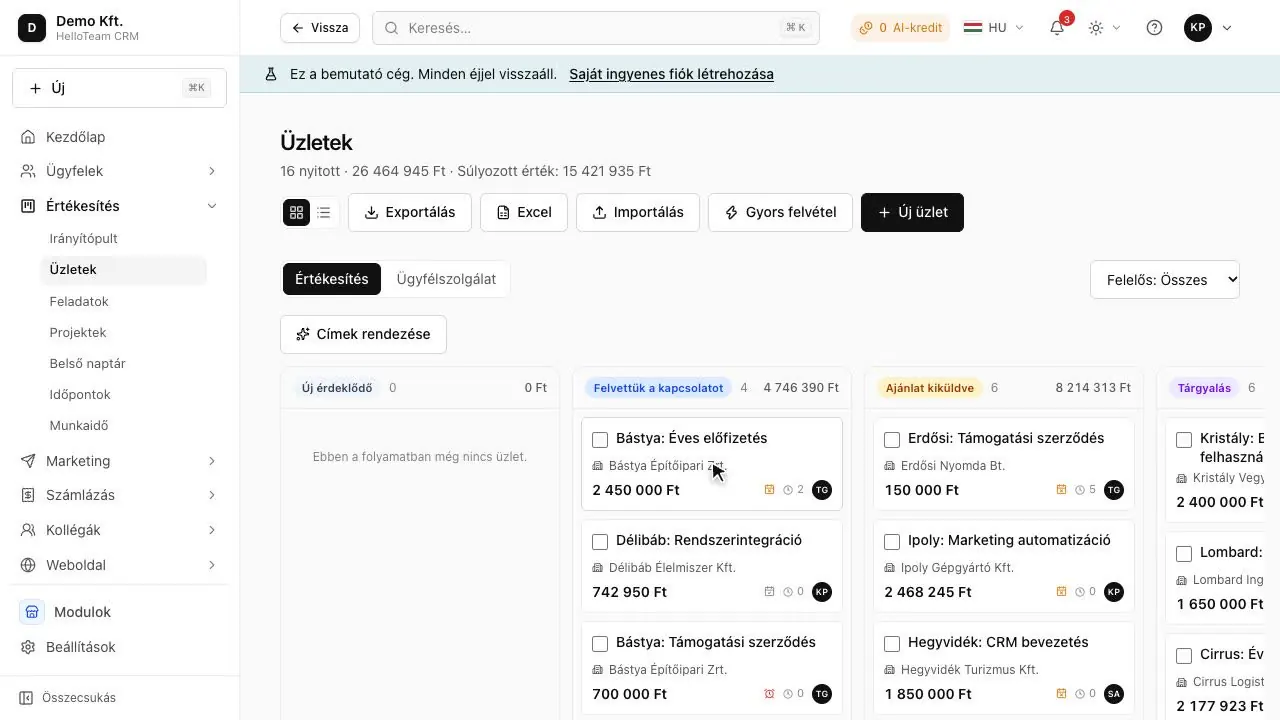
What is a sales pipeline, and how is it different from a list?
A sales pipeline arranges open deals by stage, from the first contact to a deal won or lost. Each deal sits in a column, and moving it on is a single gesture.
The rows of a spreadsheet tell you who your customers are; a pipeline also shows where each deal stands. You can see how many deals and how much value sit in each stage, and where they stall. A deal that has stayed in one stage much longer than usual usually needs attention.
Another point in its favour: a new colleague, or you yourself after a week of holiday, can see at a glance what the next step is with whom, without piecing it together from the mailbox.
How many stages do you need, and what should you call them?
A stage works when it is clear when a deal passes it: quote sent beats in progress, because everyone reads the first one the same way. Four to six stages are enough for most small businesses. A typical row:
- First contact
- Needs assessment
- Quote sent
- Negotiation
- Won or lost
Won and lost are stages of their own. If a service job runs a different course from a new customer, open two pipelines with their own stages and fields. HelloCRM's Deals module is free, and the free plan holds two pipelines.
What weekly routine keeps a pipeline alive?
Details
- Every open deal has a next step with a date.
- Look at what has stayed in a stage too long.
- Close a hopeless deal as lost rather than leaving it on the board.
- When a deal closes, record why it was won or lost.
HelloCRM's reports show time in each stage and stalled deals. A deal counts as stalled when it has stayed longer than is usual for its own stage, because a week in first contact means something different from a week in contract sent. The win/loss report also breaks losses down by reason, and the next step can be a dated task that, by default, sends a reminder the day before.
How far can you trust a weighted forecast?
Details
If you give each stage a probability, the system works out a weighted value. It is an estimate, not revenue. Suppose three quotes of one million forints sit in quote sent, which you gave 50 percent: the weighted value is one and a half million, but at the end of the month zero, one, two or three million comes in, never one and a half.
Issued invoices, recurring contracts and the weighted pipeline carry different certainty, so look at them separately. HelloCRM's forecast keeps the three apart too, and does not add them into one number.
The forecast improves when you check the probabilities against what actually happened from time to time. If three deals in ten from quote sent end up won, 30 percent is closer to reality than a 50 typed in by feel.
What mistakes make the board useless?
Details
- Too many blurry stages: nobody knows where to drag a deal.
- Deals with no owner: what belongs to everyone gets nobody's attention.
- Deals left open for months, which inflate the forecast.
- Probabilities set by feel and never checked against what actually closed.
- Everyone reads the stages differently: a short description of each stage, written together, helps a lot.
Where to read on
Questions
How many stages should a pipeline have?
Four to six are enough for most small businesses, plus won and lost.
How many pipelines does the free plan allow?
Two; more teams or product lines need a paid plan.
What is the difference between a pipeline and a funnel?
A pipeline shows the state of each deal; a funnel shows the ratios across the whole process.