Lead management: how an enquiry becomes a customer
Lead management is the process by which every enquiry lands in one place, gets an owner and a quick reply, and is followed until it becomes a customer or you let it go. Five steps: collect leads from every channel, assign them, reply quickly, decide which are the most promising, and give each one a next step. This guide walks through each.
Published: · By the HelloCRM team
The core CRM is free forever. Pre-register and be among the first in.
What is a lead, and what is lead management?
A lead is someone who has shown interest in what you offer but has not bought yet: they filled in a form, phoned, wrote an email, or ordered a sample. Lead management is everything that happens between that signal and the sale, or the decision to let them go.
In a small company leads are rarely lost because of a poor offer. Far more often because nobody felt it was theirs, the reply was days late, or the second call never happened because nobody wrote it down.
Where do leads come from, and how do you gather them in one place?
- A website form: a quote request or contact form.
- Phone and email: the most common, and the easiest to lose.
- An online shop: someone who ordered, or left something in the cart.
- Ads: lead forms on social platforms.
- Referrals, events, business cards: these have to be entered by hand.
The aim is for every channel to arrive in the same place, so a colleague sees the caller just as they see the person who filled in the form. Where possible, a form should create the contact directly, not land in a mailbox someone has to copy from.
Who should take the new lead?
Details
Every lead needs an owner from the first minute. There are two common ways: in turn (round robin), where colleagues take new leads one after another, or by load, where whoever has the fewest open items gets it. A lead that already has an owner, such as a returning customer, should stay with them.
Someone on leave or who has left should receive no new leads, or the lead waits in a mailbox nobody reads.
How quickly should you reply to a lead?
Details
As fast as you can, with an internal promise everybody knows, such as "on a working day we call back the same day". People asking for a quote often contact several companies at once, and whoever replies properly first has the better chance. If you cannot keep the promise, send a short acknowledgement at once and the full reply later.
How do you decide which lead is worth the most?
Details
With two simple tools. The first is a few questions in the first conversation: what they need, by when, who decides, and roughly what the budget is. The second is scoring (lead scoring): the system gives points for signals, such as an opened email, a click or a submitted form, so you can see who is actively interested right now.
A score gives an order, not a decision: call the high-scoring lead first, but the conversation decides.
How do you follow a lead through to the sale?
Details
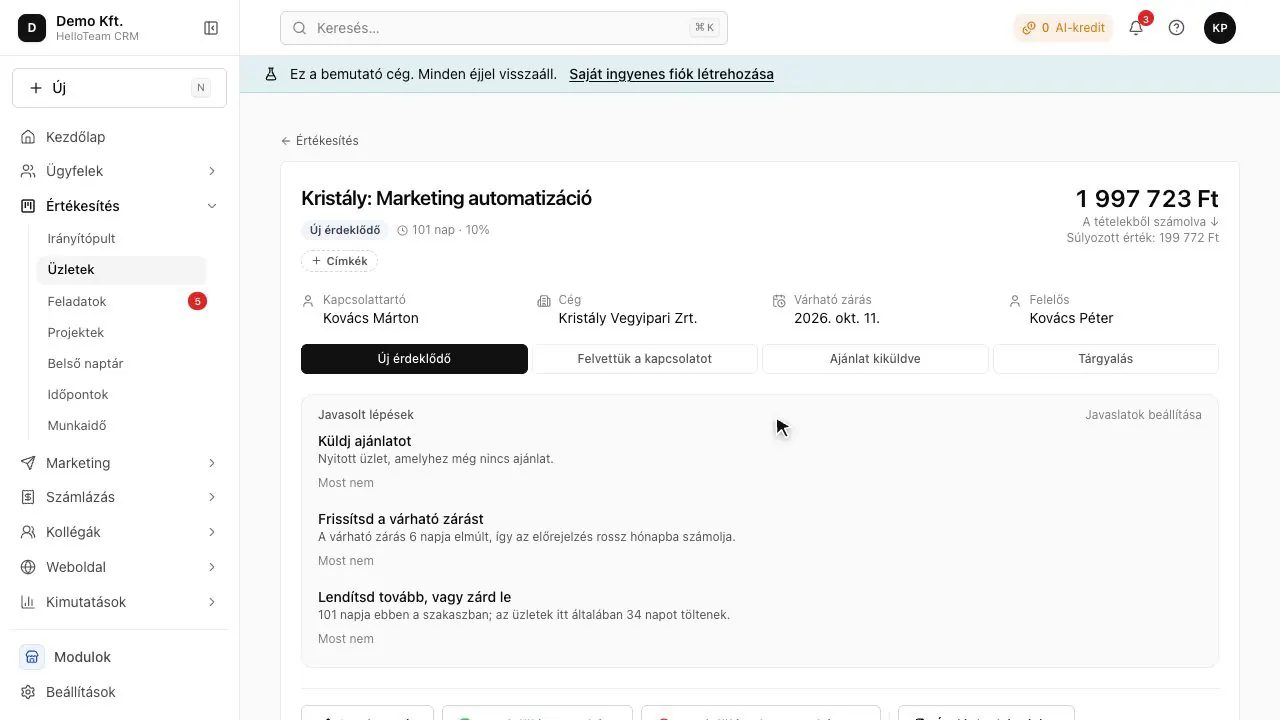
The lead should have a status (lead, prospect, customer, for example), and once there is a real offer it should become a deal in the sales pipeline. The most important rule: every open deal and every active lead has a next step, with a date. After a call, the follow-up goes in as a task at once, rather than staying in someone's head.
What about leads who are not ready yet?
Details
Many people will not buy now but will in six months. Do not delete them and do not call them every week: a less frequent, useful newsletter or a scheduled reminder keeps the relationship alive. Send newsletters only to people who consented and whose consent you can demonstrate (GDPR Article 7(1)); every mail needs an unsubscribe link.
How does lead management work in HelloCRM?
Details
- Website forms, shop orders and lead ads create contacts by themselves, and forms can use double opt-in.
- Under Settings → Distribute new contacts, deals and tickets are handed out in turn or by fewest open items; only people still employed receive, and those on leave are skipped by default.
- Scoring is on by default: email opens, clicks, form submissions, page views, new deals and logged activities earn points.
- A contact's status is lead, prospect, customer or inactive, and after a call the follow-up is booked in one click.
Contacts, deals and tasks are part of the free plan; Forms and Automations are paid modules, each with a 3-day trial.
Which mistakes lose leads?
Details
- A shared mailbox where everybody assumes someone else replies.
- A lead with no owner, or with a colleague who is on leave.
- A follow-up that is written down nowhere.
- The same template mail to everybody, without reading the question.
- A newsletter to someone who never asked for it.
In short
Lead management is five steps: gather every enquiry in one place, give it an owner, reply quickly, decide which are most promising, and give each one a dated next step. Most leads are not lost to a poor offer but because nobody felt they were theirs, or the follow-up was never written down.
Where to read on
Questions
What is the difference between a lead and a customer?
A lead is interested but has not bought; a customer has bought or signed. In between there is often a prospect stage, when a conversation is already under way.
What is round-robin lead assignment?
New leads go to colleagues in turn, one after another, so everyone gets the same share and every lead has an owner from the first minute.
Does a small company need lead scoring?
It is not essential, but it helps decide whom to call first when many leads arrive at once. With few leads, the questions in the first conversation are enough.
May I send a newsletter to every lead?
Only to those who consented and whose consent you can demonstrate (GDPR Article 7). A quote request on its own is not consent to a newsletter.
Sources
This is general information, not legal or tax advice. The rules come from: Az (EU) 2016/679 rendelet (GDPR), EUR-Lex (checked )