Payment reminder template: three letters for an overdue invoice
Three letters, each firmer than the last, are usually enough for an overdue invoice: a friendly reminder a few days after the due date, a second one a week or two later, and a final notice with a deadline. Each states the invoice number, the due date, the amount still open and how to pay. All three templates are below, ready to adapt.
Published: · By the HelloCRM team
The core CRM is free forever. Pre-register and be among the first in.
When should you send a payment reminder?
Once the due date has passed and the money has not arrived. Most late payments are not bad faith: the invoice got lost, a colleague is on holiday, or the buyer simply forgot. An early, friendly letter settles these and does not spoil the relationship.
It pays to decide the steps in advance and follow them the same way every time. HelloCRM's default is three steps: 3, 10 and 30 days after the due date. That is a starting point, not a rule; adjust it to how your own customers pay.
What should a payment reminder contain?
- The invoice number, so the buyer's bookkeeping finds it at once.
- The original due date, and how many days ago it passed.
- The amount still open; after a part payment, only the balance.
- How to pay: the bank account, the reference, or a payment link.
- Whom to contact if something is wrong with the invoice.
- A sentence for the case where they have paid in the meantime.
What does not belong: reproach, warnings in capitals, or threats you do not mean. The third letter can be firm, but it should stay polite and factual.
What should the letters say? Three templates
Details
The three letters below are HelloCRM's own default wording; the invoice's details go in place of the square brackets. You can rewrite them, but keep the structure: each states the same facts, only more firmly.
- First reminder (3 days after the due date). Subject: Reminder: invoice [invoice number]. Text: Dear [customer name], a friendly reminder that invoice [invoice number] was due on [due date]. The amount still open is [amount]. If you have already paid, please disregard this message. [payment link] Kind regards, [company name]
- Second reminder (10 days after the due date). Subject: Second reminder: invoice [invoice number]. Text: Dear [customer name], invoice [invoice number] is [number of days] days overdue and [amount] is still open. Please settle it in the next few days, or let us know if something is wrong with it. [payment link] Kind regards, [company name]
- Final notice (30 days after the due date). Subject: Final notice: invoice [invoice number]. Text: Dear [customer name], invoice [invoice number], due on [due date], is [number of days] days overdue. Please pay the outstanding [amount] within 8 days. [payment link] Kind regards, [company name]
What tone should each step take?
Details
The first letter assumes the buyer forgot: it reminds them and gives a way out ("if you have already paid"). The second states a fact (so many days overdue) and asks for an answer: pay, or say if there is a problem. The third sets a deadline.
If a buyer answers the second letter by saying something is wrong with the invoice, pause the reminders for that invoice and talk it through. If they are right, an issued invoice is put right with a storno or a corrective invoice; which one, your accountant will tell you.
What if they still do not pay after the third letter?
Details
At that point letters have done what they can: call, and ask what happened and when they can pay. An agreement to pay in instalments often brings more than another notice. If that does not work either, discuss the next step (late-payment interest or debt collection, for example) with your accountant or a lawyer; their rules are not the subject of this article.
Meanwhile it is worth deciding whether the customer gets new work or deliveries while the old invoice is open. That is better fixed in advance as a rule than argued over case by case.
How does HelloCRM send these by itself?
Details
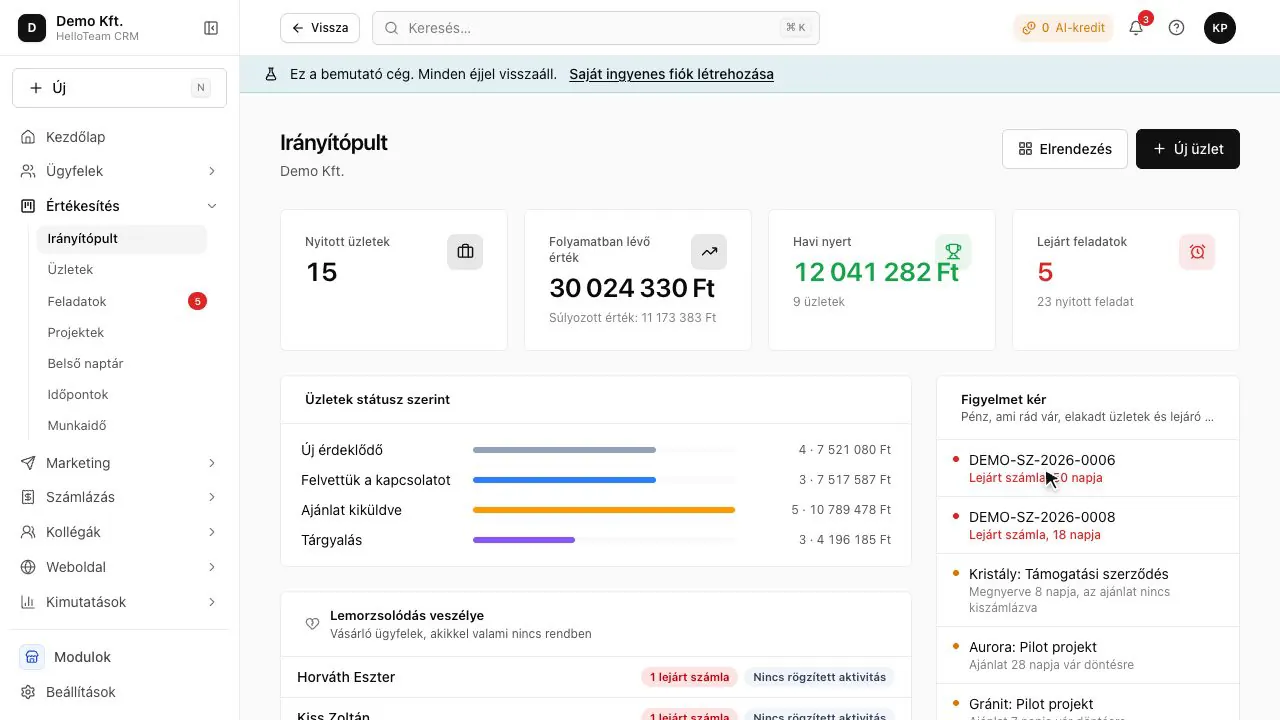
In the Invoicing module, payment reminders are switched on in the settings, and until you switch them on not a single letter goes out: mail to your customers is your decision. You can change the days and the wording, with up to five steps; the texts can carry the invoice number, the amount, the due date, the days overdue, the customer's and your company's name, and a payment link.
- Each step sends one letter, even if the run starts twice.
- If the invoice has been paid or cancelled in the meantime, the next letter does not go.
- Reminders can be paused on one invoice while it is in dispute.
- It does not write to an address that bounced or complained, and says so on the invoice.
- Every letter is on the timeline of the invoice, the contact and the company.
Overdue items are also shown aged: who owes, and since when. To automate more (opening a task for the owner when an invoice goes overdue, for example), the Automations module can start a workflow on an overdue invoice. The modules are paid add-ons, each with a free 3-day trial.
Which mistakes should you avoid?
Details
- The first letter only goes out after a month, when it is harder to ask.
- The letter states the full amount although the buyer has already paid part of it.
- It does not say how to pay, and the buyer has to ask.
- A notice goes out for an invoice already paid, because nobody recorded the payment.
- Each letter goes out in a different tone, worded by a different colleague.
In short
Three letters, each firmer than the last, are usually enough for an overdue invoice: a reminder a few days after the due date, a second a week or two later, and a final notice with a deadline. Each should state the invoice number, the due date, the amount open and how to pay; HelloCRM sends them as steps you switch on, and stops once the invoice is paid.
Where to read on
Questions
How many days after the due date should the first reminder go?
There is no single right number; HelloCRM's default is 3 days, then 10 and 30. Adjust it to how your customers usually pay.
What is the difference between a reminder and a final notice?
A reminder politely points out that the invoice is overdue; a final notice sets a deadline for paying. The third template is one.
Does the reminder go out if the customer unsubscribed from the newsletter?
Yes: a payment reminder is not a newsletter, so an unsubscribe does not stop it. It does not go to an address that bounced or complained, though.
Do the letters stop once the invoice is paid?
Yes: the next step only goes out if the invoice is still open.