A free CRM: what to watch for before you choose
A free CRM is a good choice when it is a real plan with no time limit (not a trial), its limits (users, contacts, emails, storage) fit your company, and your data stays and can be exported when you outgrow it or stop paying. Before choosing, also work out what the next step costs.
Published: · By the HelloCRM team
The core CRM is free forever. Pre-register and be among the first in.
What is the difference between a free plan and a free trial?
A free trial is a paid plan you may use without paying for a set period (often two weeks or a month); at the end you pay or lose access. A free plan, by contrast, has no expiry, and in exchange it has limits: fewer users, fewer contacts, fewer features.
The two are for different things. A trial lets you look at a paid system on real work. A free plan lets a small company keep its customers in it for good at no cost, and pay only when it really needs something. When a page says free CRM, read the small print: does it expire, and what happens to the data afterwards?
According to the vendors' own pages (read on 2026-10-18), a free plan with no time limit is offered by, among others, HubSpot CRM, Zoho CRM, Bitrix24. The detailed, sourced comparison is on the comparison pages.
Which limits really matter?
Every free plan has limits, and that is fine. The question is which limit your company hits first, and how soon.
- Users: how many people can sign in. If there are three of you today and five next year, this can decide it.
- Contacts: how many customers and leads fit. Count the old, inactive customers too.
- Emails a month: if you also send newsletters, the monthly allowance can run out quickly.
- Storage: attached quotes, photos and contracts add up.
- Pipelines: if you run two separate sales pipelines (products and service, for example), do both fit?
- API and integrations: connecting a shop, invoicing software or another system is often paid only.
Write down today's numbers and, beside them, what you expect in a year. If the expected number is close to a limit, look at the paid step's price now.
What does HelloCRM's free plan include?
Details
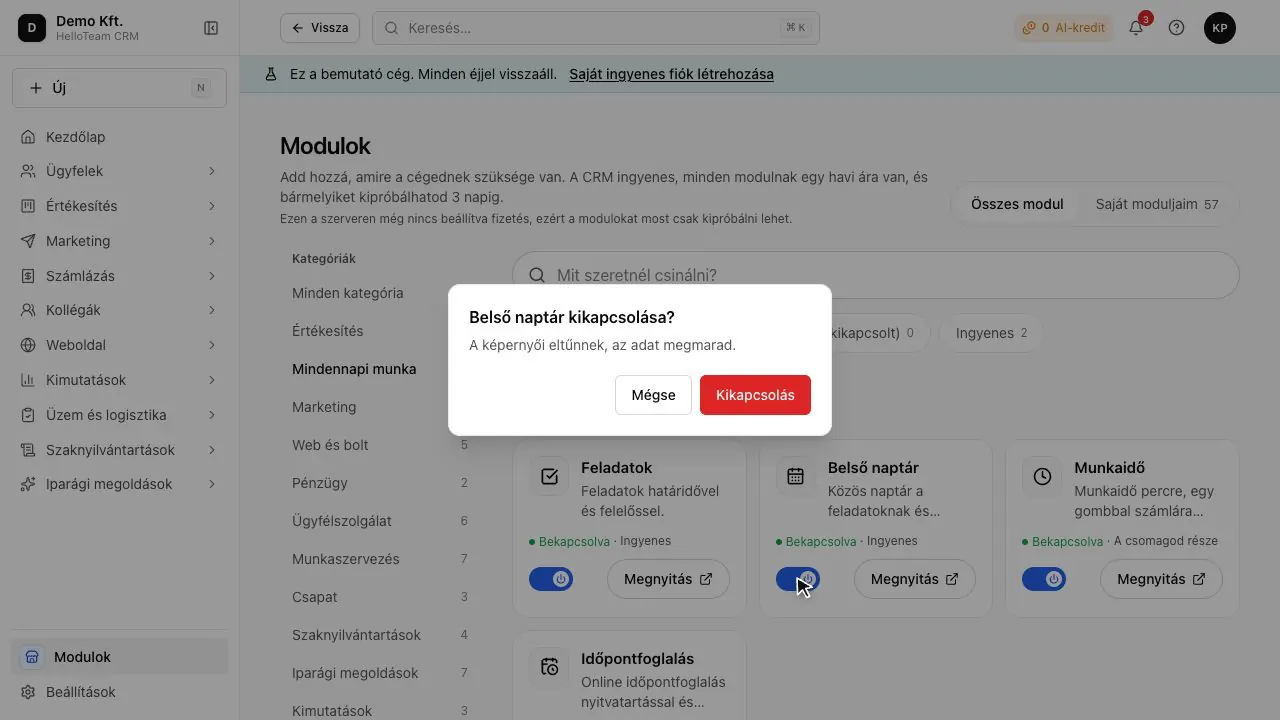
As an example, our own plan: in HelloCRM every new account starts on the free plan, with no time limit and no card. It includes these modules: Deals, Customer portal, Tasks, Calendar, Mailboxes, Reports, AI assistant. Always free: Contacts and companies, Notes and the timeline, Files, CSV import and export, GDPR tools.
| Limit | Value |
|---|---|
| Users | 3 |
| Contacts | 2,000 |
| Emails / month | 500 |
| Storage | 1 GB |
| Pipelines | 2 |
| API keys, SMS, AI | None |
Whatever the free plan leaves out can be added module by module: quotes, invoicing, newsletters, automations or the helpdesk. A small team can start keeping customers, deals and tasks this way, and pay only when it needs one specific area.
What happens when you outgrow the free plan?
Details
Outgrowing comes in two kinds: you need more of the same (more users, contacts or emails), or a new area (invoicing, campaigns, a shop). The two cost money differently, so look at them separately.
- A new area in HelloCRM: one add-on module (prices coming soon), and each can be tried for 3 days before you pay.
- The price is fixed at purchase, so a later price-list change does not rewrite an existing subscription.
- If you need to go past the limits (more than 3 users, for example), that is a matter of plans; plan prices: coming soon.
With any system, ask in advance: if you cross a single limit, do you have to buy a whole higher plan, or only what is missing? Over a year that difference can add up.
What happens to your data if you stop paying?
Details
This is the question asked least often before choosing and the one that matters most afterwards. Some systems make the account read-only when payment stops, others delete the data after a while. Ask in writing what happens.
- In HelloCRM, when a paid period ends, the company falls back to the free plan: the core CRM stays writable, paid modules switch off, and nothing is deleted.
- A cancelled module stays until the end of the paid period, then switches off, and its data stays; switch it on again and everything is where it was.
- So a company that paid and stopped is not left worse off than one that never paid.
How do you take your data out if you switch?
Details
A free plan is only truly free if you can also leave it. If export is paid, works only on request or is incomplete, the price becomes whatever staying costs.
- Check whether you can export contacts, companies and deals yourself in a common format such as CSV.
- Try it in the first week, not on the day you cancel.
- Check whether the notes and files attached to customers are available too.
In HelloCRM, CSV import and export are for everybody, on the free plan too, and with the GDPR tools all of a person's data downloads in one click if they ask. We make switching easy the other way too: Contacts → Import recognises common Hungarian and English headers.
Where do the hidden costs hide?
Details
- A per-user fee: the next step's price grows with the team.
- A basic feature as a paid add-on: invoicing or newsletters at an extra fee.
- The sending allowance: going past the monthly email count can mean an extra fee or a plan change.
- Integrations: connecting a shop or invoicing software through a connector bought from a third party.
- Outside services: invoicing software (such as Számlázz.hu or Billingo) has its own fee, which they set.
An example: suppose a three-person service business in Debrecen adds the Quotes, Invoicing and Products modules to the free core. That is three paid modules (prices will be published soon); the Számlázz.hu or Billingo fee comes on top.
Who is a free CRM enough for?
Details
Many small companies find it enough for good when their work is mostly keeping track of customers, deals, tasks and emails. It is worth moving on when a specific area is missing, not because more features sound good.
- It can be enough for a one-to-three person service company with under 2,000 contacts, which issues invoices elsewhere and rarely sends newsletters.
- It can be enough for a new business that first wants to find its own sales process.
- It may fall short if you want to issue invoices from the CRM too, because that is a paid module.
- It may fall short when more colleagues work with customers than the plan allows.
- It may fall short if you would send more than 500 emails a month, or connect a shop through the API.
In short
A free CRM is good when it is a real plan with no time limit rather than a trial, its limits fit your company, and your data stays and can be exported when you outgrow it or stop paying. HelloCRM's core is free for good; when a paid period ends the company falls back to the free plan and nothing is deleted.
Where to read on
Questions
Is HelloCRM's core really free for good?
Yes: the free plan has no time limit and needs no card, and every new account starts on it.
How much storage comes free?
1 GB, for attached files together. The other limits: Users: 3, Contacts: 2,000, Emails / month: 500, Storage: 1 GB.
Can I try a paid module before paying?
Yes, every paid module can be tried for 3 days, once per module.
Is there an API on the free plan?
No: API keys, SMS and AI are not part of the free plan.